
Why Voiceover Becomes the Bottleneck in High-Volume Content Production
Many content teams know the pattern.
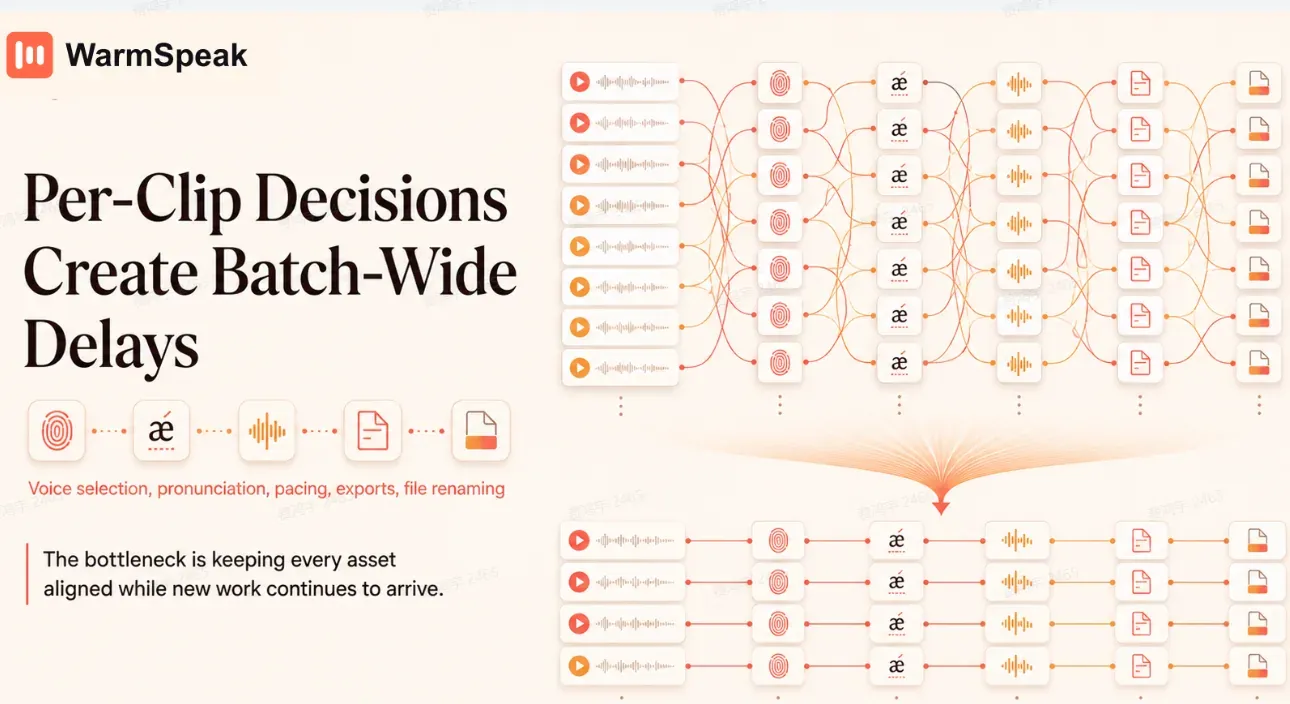
The scripts are approved, the edit structure is in place, and the publishing dates are set. Yet the project stalls at voiceover. One narration track sounds too flat and needs a new direction. A product name is pronounced incorrectly and has to be fixed. One sentence changes at the last minute, which means regenerating, renaming, and redistributing the audio. When several pieces are moving at once, chat threads fill with preview files and no one is completely sure which version is final.
Text-to-speech has made it easy to produce a piece of audio. But once content production scales, the job is no longer to generate one voice track. It is to complete dozens—or hundreds—of voiceover tasks continuously, without losing control of quality, revisions, and delivery.
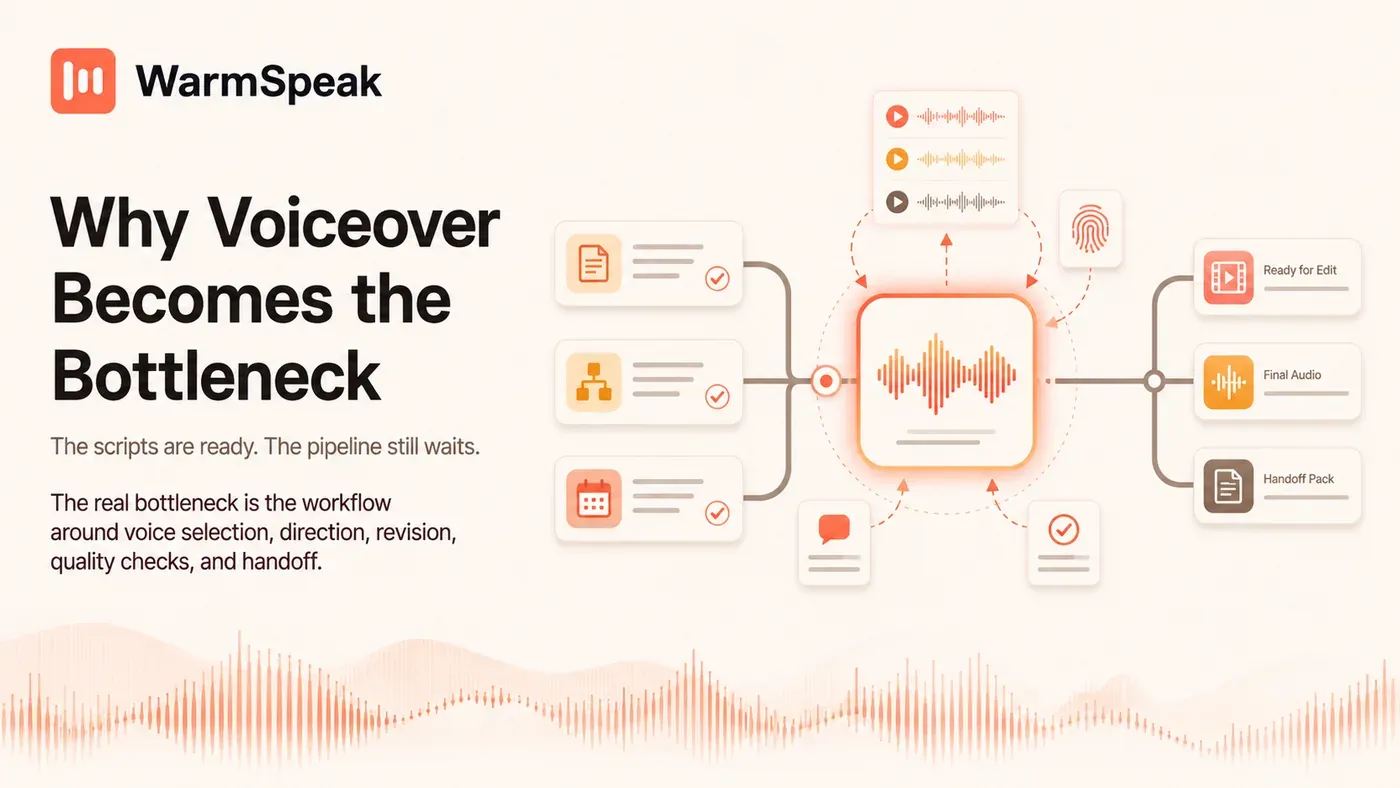
The real bottleneck is rarely text-to-speech itself. It is the full workflow around voice selection, direction, revision, quality checks, and handoff.
Fast generation does not guarantee fast batch production
For a single short video, voiceover can feel straightforward: paste in the script, choose a voice, generate the audio, and try again if the result does not fit. The time involved may seem manageable.
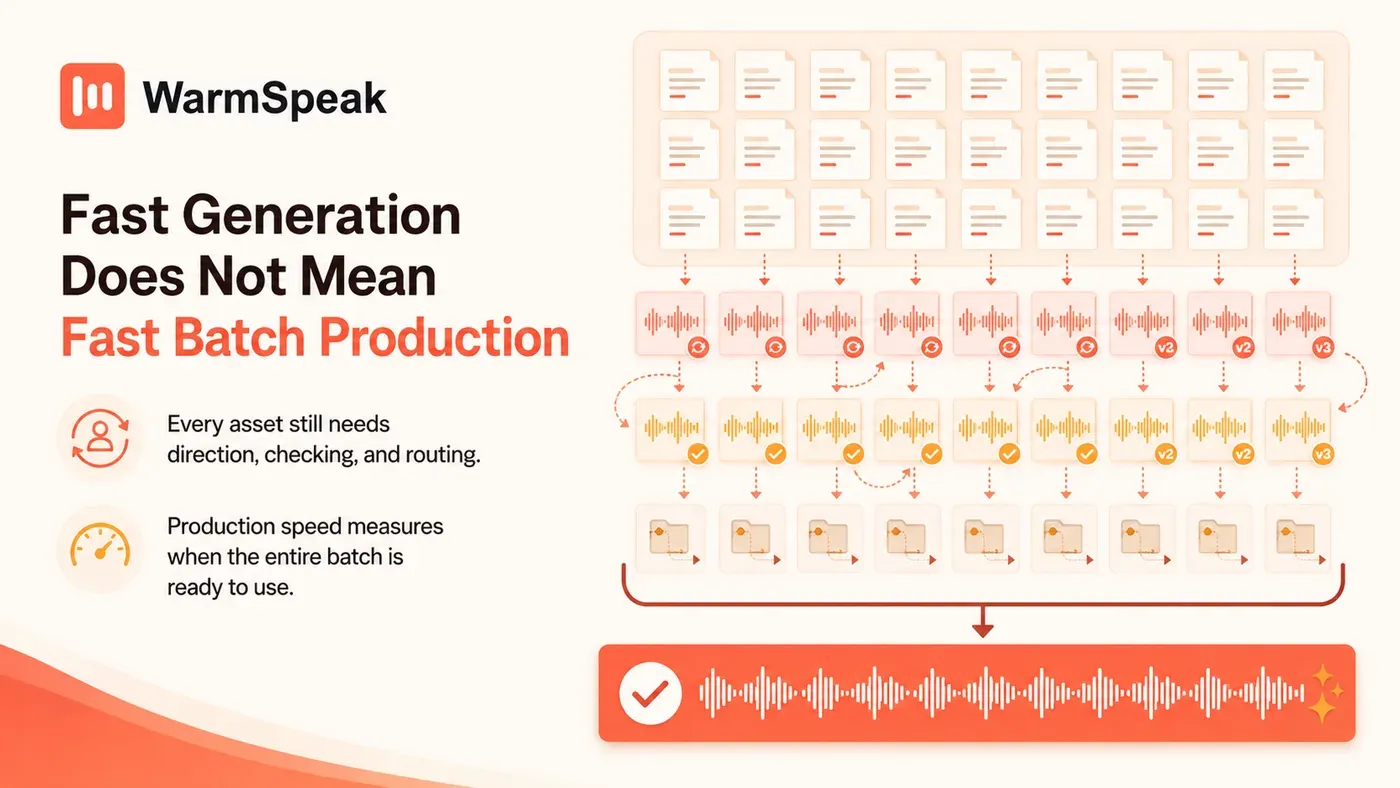
The equation changes when a team runs a short-form video network, produces a course in batches, or releases long-form audio on a regular schedule. Even if every asset is less than a minute long, the team still has to prepare each script, confirm the voice direction, produce the audio, check the result, and route the correct file to the correct editor.
Content also refuses to stay still. A campaign owner updates a selling point. A producer changes the opening. A course team corrects a detail before release. Audio that was finished yesterday may need to re-enter production today.
At that point, the delay is not caused by one slow generation. It comes from having people stand beside every asset and repeat the same decisions and handoffs dozens of times. When only a few tracks fall behind, editing, approval, and publishing all begin to wait.
Voice direction and iteration take more time than expected
Voiceover is not finished simply because every word has been spoken. The same script needs a different performance when it is used for a product demo, an educational video, a documentary, or a campaign asset.
A product introduction should sound clear and persuasive without becoming a mechanical announcement. Educational content needs a steady, listenable pace. Short-form narration must reach the point quickly without sounding rushed. Documentary and long-form work depends more heavily on rhythm, pauses, and sustained listening comfort.
When the voice direction is wrong, an otherwise accurate read still feels disconnected from the visuals. The team goes back to voice selection, pacing, emphasis, and delivery. Brand names, character names, technical terms, and special pronunciations add another layer of checking before the audio can move forward.
Each adjustment is small on its own. Across dozens of assets, however, repeated changes to tone, pauses, emphasis, and pronunciation quickly consume the time that fast generation was supposed to save.
Generation speed measures how long one attempt takes. Production speed measures when the entire batch is ready to use.
Script revisions quickly become an audio version-control problem
Content production is rarely a one-draft process. A revised line, a deleted shot, or an updated lesson point can send completed audio back into production.
With one asset, making a new version is easy. With several assets in progress, the team must keep answering a more difficult set of questions:
• Which audio file matches the approved script?
• Was the full narration replaced, or only one line?
• Has the previous file been retired?
• Which editor should receive the new version?
When those answers live across chat history and local folders, mistakes become more likely as the file count grows. A correct track may be attached to the wrong video. A new version may exist while the editor continues using the old one. A small pickup may force someone to replay the entire file just to confirm what changed.
Batch voiceover efficiency therefore includes far more than generation time. Revision tracking, checking, naming, and file-to-project matching all matter. If the handoff structure is unclear, faster generation simply creates a larger pile of files waiting to be identified.
Consistency requires more than reusing the same voice
Batch production is not only about volume. In a course series, recurring show, audiobook, brand channel, or short-form content network, audiences experience multiple pieces as one body of work. Changes in voice and delivery are easy to notice.
A course that begins with a calm, clear pace may suddenly become hurried. A brand channel may sound measured in one video and exaggerated in the next. An audiobook may change its pauses and pronunciation from chapter to chapter. Even when every individual track is usable, the series can still feel fragmented.
Consistency includes pace, pauses, emphasis, terminology, pronunciation, and overall delivery—not just the selected voice. Establishing a clear voice direction before production reduces the need to make the same judgment again for every script.
For a personal brand or recurring series that needs a recognizable voice over time, voice cloning can also support continuity when it fits the project. The point is not the technology itself. The point is to give future content a stable and reusable voice standard.
What a batch project needs to preserve is not one voice setting, but a complete set of delivery decisions that can hold across the series.
Voiceover is complete only when the audio is ready for editing
As content volume grows, teams do not necessarily need another text-to-speech interface to operate. They need to spend less time repeating production steps and sorting the resulting files.
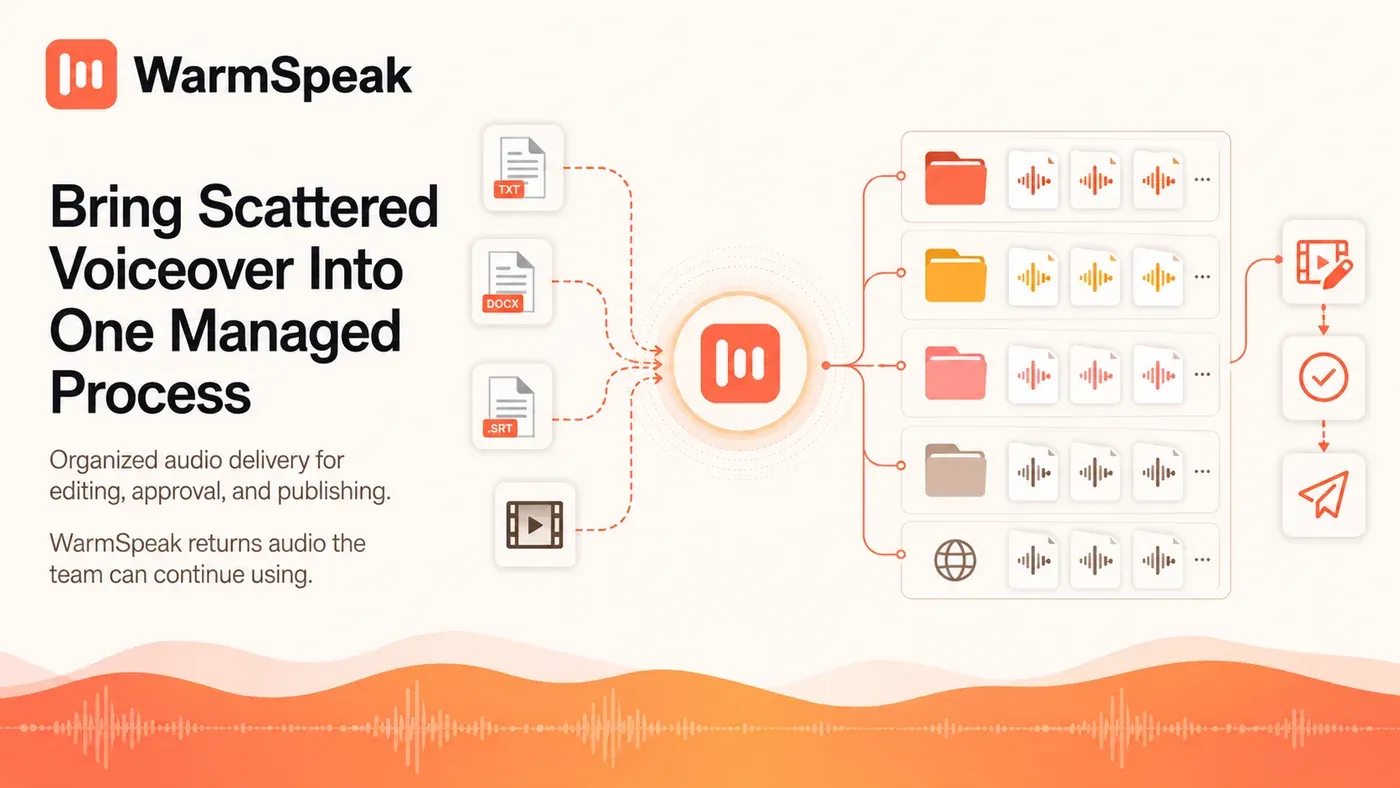
This is the part of the workflow WarmSpeak is designed to take on. A content team can provide existing scripts, documents, subtitle files, or video references, along with the content type, production volume, target language, preferred voice direction, and delivery requirements. WarmSpeak then organizes the batch around the actual use case, covering voice matching, production, systematic quality checks, and file preparation.
The team does not have to supervise every generation or manage repeated exports and file matching on its own. Pronunciation, pacing, pauses, and overall delivery are handled in relation to the content’s purpose. When scripts change, updated audio can remain connected to a clear version and delivery structure.
The result is not a folder of preview files that still needs to be deciphered. It is an organized audio delivery that can move into editing, approval, and publishing.
For someone producing an occasional video, a self-service text-to-speech tool may be enough. For a team publishing dozens of videos each week, producing long-form content continuously, or coordinating versions across languages, the scarce resource is a workflow that can reliably absorb the volume.
WarmSpeak does not add another voice-generation step for the content team. It brings scattered voiceover work into one managed process and returns audio that the team can continue using.
A finished script should not be the beginning of another long production cycle. Voiceover stops being the bottleneck when the entire batch is produced to a shared standard, clearly organized, and ready for the next stage.
Learn more about WarmSpeak
Visit the website: WarmSpeak official website
Submit your voiceover project: Contact us